I think I will start my fellowship in April.
April sounds like a good month. My current boss wants to keep me until the end of February, and now that I have some leverage (I can leave any time I want) I get to do fun stuff on the current project. No more data entry!
Between February and April I am going to do... NOTHING.
SRSLY.
I haven't had a holiday where I didn't take work with me since before grad school. Um, 2003, I think. I submitted my PhD half way through my first semester of teaching full time, so yeah, no time off to recover there. I can't think of anything more blissful than four full weeks without any responsibilities. I might not even get out of bed.
When I start, I move buildings/departments/offices within our university. Linguistics at our university is split into two departments, and this fellowship will be held within the other one, since their research focus is more in line with the topic of my new project.
It's a pretty different culture over there. Besides linguists, my current department is full of language teachers and literature specialists.. They also all have huge teaching loads, so everyone is always frantically rushing from one class to another, and it's impossible to schedule social activities.
The other department is full of anthropologists and historians. Anthropologists are weird. They sleep during the day and work at night. They lurk around tearooms and photocopiers taking surreptitious notes about other people. They like seminars and workshops a LOT. They go away to the field for a year at a time and return looking slightly feral, no longer quite in touch with modern society, and smelling faintly of quinine.
The new department has morning and afternoon tea together EVERY DAY. No one teaches. They have weekend retreats in the middle of nowhere. They have secret parties that they don't invite the teaching staff to. (And I just got my first invite to one yesterday). Apart from the PhD students, they are all male. I feel like I am joining some sort of fraternity.
The building my office is in right now is solid and square and conventional. It has windowsills full of parrots, and no air-conditioning. It has one- and two-person offices, depending on one's status. The new building where the "other half" lives is actually three hexagonal three-and-a-half-story buildings connected by random walkways on split half-levels that are only accessible from hidden stairwells. Once inside, no one ever finds their way out again. Staircases move from week to week and sometimes walls spring up in the middle of corridors. The linguists live in two places: the "dungeon" (basement), single-person offices below ground with no windows; and the top level of the building, which has large airy offices that are shared by four to six people apiece. The dungeon is overheated and the upstairs is over-air-conditioned. I wonder where I will be?
Starting April, for the following three years, I get to do nothing but research, all day every day. I have money to go to several conferences a year, including internationally. I can do a whole heap of fieldwork. I can employ a research assistant. My time is my own, and I answer to no one except the funding body, who require annual reports. This degree of freedom makes me kind of dizzy.
I think I will buy a lot of stationery.
Saturday, October 30, 2010
Random bullets of "I still can't quite believe it"

Sunday, August 22, 2010
How to communicate with the natives
Lately I've been spending a lot of time poking around in elderly grammars and dictionaries of Aboriginal Australian languages. Here are a few of my favourite (i.e. most horrifying) finds:
From a language sketch from 1858, the following sentences are translated (since presumably these are the sorts of communications one might need to make with the "natives"):
"Now my blackfellows, make haste and get your breakfast. We will be going."
"Go and fetch them, there's a good fellow!"
"You are lazy! Dry your trousers!"
"Come here tomorrow and cut me some wood and me give you white money."
From a book of a similar age, the paradigm for "you are a harlot, she is a harlot, they are all harlots".
And from the latter book, a word is given that is translated as "intercourse, in both the good and the crude sense".
(And here was me thinking that the "good" sense was the crude sense.)
Monday, August 02, 2010
Doors: who needs 'em?
Of all the conversations I recorded and transcribed during my time on Pirate Island, some of my favourites are practically useless for linguistic purposes, but still amusing snippets of day-to-day life. Like the following.
The context was that Edward, my host, was just finishing up a wood carving that was to be a gift to a nephew on his upcoming birthday.
Edward: "And after this one, I has another project."
Me: "Oh yeah? What is it?"
Edward: "Fixing Kori's door."
Me: "What's wrong with Kori's door?"
Edward: "He haven't got no door."
Wednesday, July 28, 2010
Harmless and misguided advice
At a career-coaching workshop today (don't ask), we were given the advice that we will come across more positively (and feel more capable) if we always replace the word but with and.
This is not a smart thing to say to a bunch of academics.
Philosopher: "But—"
Workshop coordinator: *Ahem*
Philosopher: "AND the two are not logically equivalent."
Computer science guy: "If I do that in my code, my compiler will barf."
Linguist: "Sometimes 'and' doesn't make grammatical sense!"
We all start coming up with impossible examples of and-sentences, or ones where the sense changes dramatically if you switch from but:
"The party was all and over, when they started clearing up."
"Everyone and my father showed up to my graduation."
"I planned to go to the gym and I didn't want to."
"I would have won the Nobel Prize, and there isn't one for sky-diving."
"People! People!" said the coordinator, exasperated. "Just try it, okay? It really works! Why, just recently I had a client who kept saying how he really wanted to take an expensive training course, but he needed to find enough money. Finally, I challenged him to turn that but into an and. So he tried it out: 'I really want to take that training course, and I need to find the money for it.' And just like that, he turned things around! Now he's taken the course!"
I asked, "Where did he get the money?"
"I don't know," said the coordinator, with a you are missing the point glare. "I guess he used a credit card."
I smile. "So he did the training course AND he's now hugely in debt?"
Saturday, July 24, 2010
More on the Robinson Crusoe experience
One of the problems with my beautiful Pirate Island* is that there is really no way to get there or back. Of course, this is also one of the advantages, as it's the reason it has kind of escaped academic notice and also why it has managed to remain mostly uninfluenced by tourists or the rest of the world.
If you want to go to Pirate Island, here's what you do. You call up the one and only shipping company that is responsible for delivering supplies (a couple of times a year, on a totally irregular basis.) You have this conversation:
"So, when do you think the next boat will be going to Pirate Island?"
"Um, maybe later this year."
"So, June, July, August?"
"Yeah, probably. Sometime then."
"Okay, I'll call back in June."
Then in June: "Hi, when will the boat be going?"
"Maybe next week? Maybe next month?"
"When do you think you'll know?"
"Maybe next week? Maybe next month?"
"I would like to get a lift with the boat. Can you call me when it's going?"
"We probably won't know until the day before." (Note: it would be very difficult to get a flight out to where the boat leaves from with less than 24 hours notice.)
*sigh*
A week later: "So, how's it going with that boat?"
"Oh, we just left. But there'll probably be another one in December. Or maybe February."
So then you resort to Plan B. Plan B is that you book a flight to the closest island (still 600 km away), and then go and hang out at the docks every day, hassling the private yachts moored there until someone agrees to do a little detour (of about 200 km) and drop you off on Pirate Island on their way elsewhere. This option only applies from July to September, as that's the only time the wind and currents cooperate enough for a sailboat to approach the island. Fortunately, it takes about 10 days to find a boat willing to take you, so you have ten days of enforced cocktail drinking on the beach busy preparation for fieldwork:
 Unfortunately, what nobody told me until AFTER I landed on Pirate Island, is that there's a little conspiracy which might stop you getting off again. First, yachts kind of depend on currents and winds, which only let them go in one direction past the Island. This means you aren't going to get a hitch-hiking opportunity to go back to your original departure point. Secondly, the only place yachts are going when they leave Pirate Island is to another country. And as Pirate Island isn't an official point of departure for the country it belongs to, it's actually illegal for you to hitchhike off it with one of those yachts. Now, I did kind of know about this, but all the yachties I spoke to before I left said, "Yeah yeah, but no one really cares about that. If it was me, I'd be happy to take you anyway."
Turns out, tiny islands full of people who get little opportunity to exercise their authority over people outside of their own family LOVE bureaucracy. Oh yeah. And there is NO WAY they are letting you depart without the proper paperwork.
 One of the locals, inspecting my research for compliance with government regulations
Once I discovered all this, I realised I was going to be stuck on Pirate Island for the rest of my life.
Fortunately for me, for the first time in about 30 years, a government boat was doing a tour of all the islands in order to audit them and make sure they were complying with all government regulations. (Like, Dude, really: use life-jackets. And maybe your kids should actually attend school sometimes. And when did you last have a pap smear? What? No doctor? That's no excuse.) They were on a boat with an engine, and they were going back to the main island. And they had room for a stray linguist. Well, not really: they were licensed to carry 6 people, but ended up taking 11.
 The one point of connection with the outside world, and how I found out about the incoming government boat
On the one hand it was probably lucky that I had visions of having to stay on the island forever. The seasickness on the outward trip was so horrific (five solid days of throwing up every time I opened my eyes), that it took a lot to convince me to ever set foot on a boat again. The only thing worse than that would have been... well, staying. It wasn't until about two weeks before I left that I heard about the government boat that would be coming through, and by then my only reaction was a heart-felt hallelujah! Unfortunately, what I heard was, "Government boat coming. You can get a lift home. Maybe on Wednesday." Then, "Boat maybe not coming Wednesday. Maybe Friday." Then, "I saw the boat this morning! Nah, just joking you. Ha ha!" Then, "There's a boat coming in! Probably your boat, eh! You can go home! No, wait, wrong boat. Just some French tourist."
Anyway, all of this is background to the real point of this post, which is that I've just been looking back through the diary I kept during the trip, and re-discovered my journal entries for the final few days on the island. This is how they began:
31/08/09
The government boat** is supposed to arrive today. No sign yet.
4/09/09
The yachts all had to leave last night because the wind changed to the North. Does this mean more delay for the S.C.? Besides missing my flight and imperiling my job, I'll go mad if I'm trapped here much longer.
5/09/09
Where is my boat?
[At this point, I seem to have given up keeping the diary, and instead have started writing personal stuff directly into my fieldwork notebook. (I told you I'd go mad.)]
9/09/09
[Scrawled underneath a description of accent differences between women and men]
Still no freaking boat.
10/09/09
[Next to a set of examples of question formation]
The boat arrived last night but has engine trouble and has torn its sail. The one person with mechanical skills is refusing to help repair it because the boat owner did something to piss them off three years ago. I'm never going to get out of here.
11/09/09
[Under a description of passive constructions]
I want to go home.
And then, it appears, I did.
 Waving goodbye as the dinghy moves away from the shore, carrying me to the boat which would carry me to the main island, which had a taxi which would carry me to the airport, where an aeroplane would carry me (six days later, without any sleep, shower or change of clothes—sorry, fellow passengers!) HOME.
 The most beautiful sight I saw all month
* Yes, this is a pseudonym, but it's what people in my department generally refer to it as.
**the initials of which are S.C.
Friday, July 16, 2010
While we were sleeping
Well, okay, while I was having a little hiatus over the past year or so, lots of things happened. Some of them are deadly boring: I went to bed and got up more than 300 times. I had breakfast a lot. I wrote a lot of sentences. I'm pretty sure I showered. You don't need to hear about all that.
What you do need to hear about is my super cool field trip to my super cool secret location with the super cool grant funding that I did actually end up getting. I'm going to continue being cryptic about the location and all, since it is also super googleable, and now I am starting to make a name for myself in writing about it. But I'll post some little anecdotes now and again in this space, just so you don't feel you missed out.
For now, a handful of photos.
The island spent a lot of time trying to impersonate a postcard:
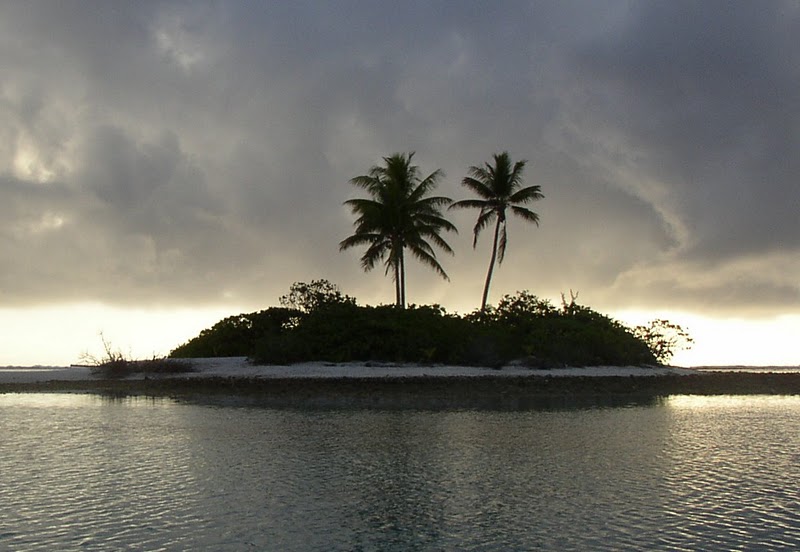
This is the main "town":
And this is what's for dinner (on special occasions: usually it would just be fish and rice):
Monday, February 23, 2009
Too much Maori used in NBL commentary!
Okay, this is weird. And kind of cool. Not only is the only free-to-air coverage of the NBL semi-final on Wednesday in Maori only, but usually when someone is "not happy with the amount of Maori language content" on TV, they mean there isn't enough of it!
Foxtel has never been happy with the amount of Maori language content there is in coverage of Breakers' gamesIf all sports coverage in New Zealand was in Te Reo only, I wonder what that would do for the number of Pakeha enrolling in Maori language courses?
Thursday, February 05, 2009
I really want to use this in a class
I'd love to use this in a class to teach about dummy subjects.  Sadly, as Geekman pointed out, that would probably require me to first explain how venn diagrams work, and then the origin of the quote. By which point it probably wouldn't be half as funny.
Sigh.
(Image from GraphJam)
Tuesday, February 03, 2009
I fail to believe this is a direct quote
In this article in the NZ news today, a bank spokesperson is quoted on the question of whether snow in London prevented people from trading the NZ dollar yesterday:
"It probably matters not for they will have time for another crack at the NZD."
Seriously? "It matters not, for..."??? Has New Zealand English changed THAT much since I've been away? Or has the ANZ begun employing wannabe Shakespearean actors?
(Also, the juxtaposition with "another crack at" made me laugh.)
Wednesday, January 28, 2009
A rose by any other name...
We have an oldish, very polite British chap in our department who works on translation. He often goes around from office to office asking people what they think the precise difference in nuance is between various words, or whether a given word has a certain connotation for people of different generations. Today's encounter, however, made me laugh.
"Excuse me," he said, passing me in the corridor, "can I ask you a question?"
"Sure," I replied.
"Do you think there is any semantic difference between the words 'tosser' and 'wanker'?"
I had to think for a moment.
"If there's a difference," I eventually replied, "I think it's very slight. Maybe 'wanker' has more of a connotation of the person being stuck up, while 'tosser' is more of a general insult."
"Hmm..." he said, "Thank you. That's helpful."
"What on earth are you working on?" I asked, as he walked away.
"Oh!" he said, "It's not for my research. I'm writing a letter to the National Radio, and was trying to decide which I should call them."
Tuesday, January 20, 2009
In related news...
(Well, related to one of the random bullets, I'm sure), the publisher for my edited volume just contacted me to ask if I have any ideas for the cover! Whee!
Unfortunately, I suspect my initial thoughts (only in my head, never fear) of
(a) an epic battle between a giant squid and a fearsome white pointer shark
(b) pretty sparkly unicorns dancing in a meadow of flowers
would probably be rejected as 'inappropriate'. Pfft.
I at least need to specify a colour. This publisher has an unfortunate tendency of going with lime green or puke yellow if the author doesn't request anything different.
So what say you, wise readers? How do I come up with a sufficiently abstract yet attractive and not-stolen-from-anyone-else idea for the cover of a book about grammatical change?
Saturday, December 06, 2008
Compare and contrast
Geekman has just been away at his centre's big annual conference. Let's compare these conferences with OUR big annual conference, mkay? (For the sake of fairness, I'll compare the situation for full time ongoing faculty in our department with the same in his.)
Locations of our big conference the last three years:
2008: Sydney (inner city)
2007: Adelaide (inner city)
2006: Melbourne (inner city)
Locations of his big conference the last three years (actual town names left off, in case of identifiability):
2008: Luxury Australian beach town; famous Australian wine region
2007: Famous New Zealand adventure/skiing resort; famous NZ tourist centre
2006: Famous Australian beach resort region.
Yes, his conferences tend to be multi-location. I.e. it's the same people and topics, they just move location halfway through in order to get to spend time in more exciting places.
Our department: each faculty member is generously given $200 per year to spend on a conference of their choice! (It might just about cover a registration fee.) Accommodation, transport, meals, other expenses are all covered out of one's own pocket.
Geekman's centre: everything is fully covered. Accommodation, transport, some food, registration, is all paid by the centre. Even for grad students. (As a comparison, one of the grad students in our department was recently INVITED to give a talk at a prestigious conference in the USA, but the dept still won't give her any money towards her expenses.)
Our conferences:
- Discounted internet access (e.g. only $20 a week instead of by the hour).
- Some free canapes and wine at book launches, of which there is usually one or two per conference.
- If you are young enough, you can probably buy coffee and food on campus at the discounted student price, if they forget to check ID.
- Sometimes there's an official conference welcome session with a little food, but it's always run out before I fight my way to the front of the queue.
- Our conference dinners usually cost $40-$60 a head, excluding drinks.
Geekman's conferences:
- Free coffee and wireless internet from an espresso bar during the day.
- Free canapes and wine every evening at poster sessions.
- The conference dinner is paid for by the centre.
- Sometimes free lunch is included.
And of course the thing that rankles most:
Here's what they gave out at Geekman's conference this year:

Admire, if the photo doesn't obscure it too much, the heavy canvas, the strong zips, the stylish design.
And here's mine:

Yes, it does indeed resemble one of those $1 canvas shopping bags. But it's not quite. No, this is MORE FLIMSY than the shopping bags I use. If you hold it up to the light, it's actually see-through. However, mine contained a PEN. I don't think the physicists got pens. DID YOU, physicists? No. Hah.
Awesome. N'est-ce pas?
Wednesday, October 22, 2008
How do you teach students to generalise?
A plea for help here. I have a student who has been finding the class difficult all semester. I find myself wanting to say, when describing her problem, "She really understands the material. She isn't struggling with the concepts when we discuss them. But she can't apply them to new data. She finds it hard to do her own analysis."
Now, if someone said that to me, I'd reply that I don't think a student really DOES understand the material unless he/she can apply the concepts to new data. But in this case I would have to disagree with my hypothetical self. My student comes up with clever, on-topic insights in class. She can explain a concept in her own words. She can even come up with original examples of a concept.
I've become more and more convinced that there's a general skill missing. And I'm starting to think the skill she is struggling with is generalisation from specific instances to "types" of instance. There's an assignment I give for homework just before we start the semantics module of the course that asks, "In what ways can the meaning of two words be related?" Underneath in brackets it says, "Hint: if you are stuck, start by considering the following pairs: man–woman; hot–cold; small–big; plant–tree; dog–animal; buy–sell; kill–die".
In her answer, the student basically wrote, "Hot is warmer than cold. Man is male and woman is female. A dog is a type of animal. A tree is a plant. Kill is the cause of die. When you buy something, someone sells it." When in class I pushed her to consider whether some of these pairs are "similar" to others, she looked really blank, and then repeated what she had already written.
So it seems to me that this is not a problem with her understanding of linguistics. And it's not that she just misunderstood this one assignment. This was the clearest example of what it is that she is struggling with, but now I look back on her other work, I think this has been the stumbling block all along. But I don't know how to go about teaching someone to generalise, if it's a skill they haven't naturally picked up. For now, I've referred the student to the Academic Skills and Learning Centre, but any suggestions for work I can do with her on this would be hugely appreciated.
Friday, October 17, 2008
Being cryptic
The advantage of a research project on a community where everyone has the same last name is that you can spam everyone with that name on Facebook and find out some very useful information...
The bad news is that I didn't get the grant I applied for on the cool blog researchy topic.
The good news is that I have an Even Better PlanTM.
There's a language that is like it was invented just to fit in with my research interests, skills and background. In fact, I am one of only a few people in the world qualified to work on it.
It's spoken in a community where fieldwork would be like a lengthy holiday in paradise.
It has never been properly described.
It's so endangered that a bunch of funding agencies would be falling over themselves to provide resources for describing it.
The islanders themselves have good reason to welcome a linguist into the community.
Any project on this language would also require (and therefore probably attract funding for) trips to Germany and New Zealand.
I WANT.
Wednesday, September 10, 2008
Mmm... ethical.
Overheard, two profs talking:
"We still need a PhD student to do fieldwork on [language]."
"Wait, which one's that?"
"That's the South American one. You know, the rainforest one with the really interesting verb suffixes."
"The one where every fieldworker who's ever gone there has been beaten to a pulp, raped and/or killed?"
"Yeah, that's right. So, anyway, we need to put out the advertisement soon."
"Do we have to tell them about the killings?"
"Well, maybe we just say something like, 'PhD project in exciting jungle location. Necessary prerequisites: Masters or honours degree in linguistics. Preferred: working knowledge of Spanish, previous fieldwork experience, strong martial arts background.'"
Tuesday, September 09, 2008
You can tell you spend too much time looking at Lolcats when...
While reading a linguistics paper today, every time I came across the abbreviation for nominative case, I found myself muttering, "NOM NOM NOM" and, "Ur noun haz a flavur".
I hope it doesn't accidentally happen in front of my students.
Friday, August 29, 2008
It's like anonymous blog comments, but in real life!

This little grammar war has been taking place on the walls of our department corridor this week. There is much speculation about who wrote the typed response—it looks like it must have been a faculty member, but no one is admitting to it. (That could be because of the words "pedantic" and "prick" that other faculty members have been bandying around ever since it went up.)
It's especially rude given that the original sign-writer is also a member of the department, and therefore the anonymous response is by one of her colleagues.
I just can't believed they cared about it this much. Whew!
(I've also been amused at the number of students I've seen taking photos of the sign. Some even admitted they are putting it on Facebook or on their blogs.)
Wednesday, July 09, 2008
Getting the geekiness level right
So I've been taking this short summer-school-type course on parsers and realisers (software for analysing sentences syntactically, or generating them based on a set of syntactic rules). We spent the last couple of days on theory, and today for the first time got let loose to play with some parsers.
The instructor suggested we input just one sentence each to start with, and then we'd go around the room and briefly say whether or not the parser had correctly analysed the sentence, and if not, why not.
But even he had to laugh when it turned out that, of the 10 people in the course, seven had decided independently to use the sentence, "All your base are belong to us."
Tuesday, June 24, 2008
Linguists are weird
Sometimes when reading linguistics papers, you come across these awesome example sentences that leave you wondering how on earth THAT came up in a fieldwork session.
Today's stunner:
Ke hang hèng keká i li.
‘He made accusations concerning his coconuts.’
Wednesday, May 28, 2008
Never do fieldwork (part 2)
(For background, the first post on this is here.)
Today we discovered that the word for "husband" and the word for "pork" in the language we are working on are the same, except for the tone. That tone we can't hear, remember? This led to us saying, "I am eating your husband" every time we tried to talk about something more normal.
Of course, in reality it wouldn't be a problem, since our speaker's village is in nothing-but-sago territory, and they are more likely to be eating people's husbands than pork.
Those people in the group with experience of sago-eating areas managed to find plenty of excuses later in the session when our speaker invited us to go visit her village.
"But it is a good village!" she said. "It is a very decent village. We are very proper people." And then, in what she must have imagined to be a deal-clincher, "It is easy to get to. There is an international airport in the city near us. And from there, the village is only one day's walk through the bush."
Then she looked us up and down appraisingly. "Maybe two days."


