Geekman: I think my talk at [conference] went pretty well. But I'm worried that it was maybe too informal.
Me: Informal talks are great! I much prefer to listen to someone talking about their research like a real live person than someone standing stiffly behind a lectern and reading off a script.
Geekman: Maybe... but all the same, next time I think I might wear shoes.
Showing posts with label physics. Show all posts
Showing posts with label physics. Show all posts
Sunday, December 21, 2008
Clearly we have different definitions of 'formality'

Saturday, December 06, 2008
Compare and contrast
Geekman has just been away at his centre's big annual conference. Let's compare these conferences with OUR big annual conference, mkay? (For the sake of fairness, I'll compare the situation for full time ongoing faculty in our department with the same in his.)
Locations of our big conference the last three years:
2008: Sydney (inner city)
2007: Adelaide (inner city)
2006: Melbourne (inner city)
Locations of his big conference the last three years (actual town names left off, in case of identifiability):
2008: Luxury Australian beach town; famous Australian wine region
2007: Famous New Zealand adventure/skiing resort; famous NZ tourist centre
2006: Famous Australian beach resort region.
Yes, his conferences tend to be multi-location. I.e. it's the same people and topics, they just move location halfway through in order to get to spend time in more exciting places.
Amount of funding/expenses covered
Our department: each faculty member is generously given $200 per year to spend on a conference of their choice! (It might just about cover a registration fee.) Accommodation, transport, meals, other expenses are all covered out of one's own pocket.
Geekman's centre: everything is fully covered. Accommodation, transport, some food, registration, is all paid by the centre. Even for grad students. (As a comparison, one of the grad students in our department was recently INVITED to give a talk at a prestigious conference in the USA, but the dept still won't give her any money towards her expenses.)
Conference amenities
Our conferences:
- Discounted internet access (e.g. only $20 a week instead of by the hour).
- Some free canapes and wine at book launches, of which there is usually one or two per conference.
- If you are young enough, you can probably buy coffee and food on campus at the discounted student price, if they forget to check ID.
- Sometimes there's an official conference welcome session with a little food, but it's always run out before I fight my way to the front of the queue.
- Our conference dinners usually cost $40-$60 a head, excluding drinks.
Geekman's conferences:
- Free coffee and wireless internet from an espresso bar during the day.
- Free canapes and wine every evening at poster sessions.
- The conference dinner is paid for by the centre.
- Sometimes free lunch is included.
And of course the thing that rankles most:
The conference bags
Here's what they gave out at Geekman's conference this year:

Admire, if the photo doesn't obscure it too much, the heavy canvas, the strong zips, the stylish design.
And here's mine:

Yes, it does indeed resemble one of those $1 canvas shopping bags. But it's not quite. No, this is MORE FLIMSY than the shopping bags I use. If you hold it up to the light, it's actually see-through. However, mine contained a PEN. I don't think the physicists got pens. DID YOU, physicists? No. Hah.
Awesome. N'est-ce pas?
Sunday, November 02, 2008
One begins to wonder what the point of a lock-up garage is.
Me: "Goddammit! The bastards broke into our car again.*"
Geekman (showing an astonishing lack of observation): "How can you tell?"
I point at the window right in front of him that has been smashed in, and then the little door that covers the petrol cap—except that technically I'm NOT pointing at the door that covers the petrol cap, since it is missing.
Geekman: "Oh, right."
We giggle. Because we are deranged.
Geekman: "It's funny. I'm not even mad this time. Just resigned."
Me: "Yeah, me too. It's like, that's just what happens to our car."
We resignedly inspect the car for further damage, and find that the lock to the boot also no longer functions. Nothing's been stolen. It would appear that the morons removed the petrol cap door without actually stealing the petrol (despite a full tank). They tried and failed to get into the car through the boot (obviously not registering that the front passenger door no longer even HAS a lock thanks to the last break in). And then they smashed a window, but didn't take anything.
They did, however, thoughtfully leave the lock from the petrol door thingy sitting on the back seat, just in case we need it for later.
I briefly consider starting a museum of all the loot car thieves have left us (current count: two pairs of scissors, a screwdriver, some paper towels, and a lock).
Me: "Do you think we should still take the car to the gym, even with the broken window?"
Geekman: "Why not? If someone steals it, at least we won't have to pay for repairs."
Me: "But you know how we were going to pick up the case of beer left in your department?**"
Geekman: "Yeah, let's do that after the gym, not before."
Because clearly it doesn't matter if someone steals our CAR, as long as we still have a case of beer. You see, then we can drink until the pain of being carless goes away, right? The logic is flawless.
I'm going to spend the afternoon making a sign to put in the car window that says, "Please don't break into this car (you bastards). There is nothing worth stealing inside, and we are not insured."
That'll work, right?
____________
* When searching to find this earlier post to link to, I googled StyleyGeek + broke into our car. Google helpfully suggested, "Did you mean: StyleyGeek broke into your car?" For the record, I would like to state that StyleyGeek has not broken into ANYONE'S car. Thank you.
** The case of beer was left over from a physics department LAN party on Friday night. I think this means we have now joined the inner geek circle. Geekman in particular seemed proud of his mastery of the 1337 lingo, as demonstrated by the glee on his face when, with a look of concentration, he looked up from his computer and tried out phrases like, "I fragged your dudes!" and "Pwned, noobs!"
Tuesday, April 01, 2008
What Geekman does for fun
Last night, this was re-deriving the equations here so he can edit the page* and make it all better.
This meant our conversations yesterday went along the following lines:
"Geekman, you know what? We had three fire drills yesterday."
"Hold on, I've lost a minus sign."
[...]
"Do you want to watch some TV?"
"No, the whole page is full of errors. I'm going to have to totally rewrite it."
[...]
"Geekman, why exactly are you doing this?"
"It's my job!"
"No, actually. Editing Wikipedia is not your job."
"But educating the masses is!"
Because the masses? They spend a lot of time hanging out at the calculating a physical force arising from a quantized field page and trading functional integrals.
_____________
* If you're a physicist and looking at that page, Geekman hasn't actually put his edits up yet, so it's still full of errors.
Saturday, November 03, 2007
Once again, physicists view the world differently
Geekman: "How did you get bruises from kicking a rugby ball?"
Me: "I wasn't kicking it. It was hitting me."
Geekman: "Relativity bites."
Monday, October 15, 2007
I thought physicists were logical
Lying in bed after switching off the light last night...
Geekman: "You're so pretty!"
Me: "It's dark."
Geekman: "But I've got my eyes shut!"
Me: "???"
Geekman: "It cancels out."
Tuesday, June 12, 2007
Physicists like to interpret things literally
Geekman enters with an envelope. "I got this from the real estate agents who manage the apartment. It's an envelope full of receipts for every rent payment we made for the whole past year."
Me: "Is there a letter or something to explain why they sent it?"
Him: "Just this piece of notepaper. It says 'with compliments'." He looks disappointed. "But they didn't give us any compliments. They could at least have said you have nice hair."
Saturday, April 07, 2007
Geekman speak
Upon hearing that a friend had called to say she would come by in half an hour, "I'd take that time estimate with a grain of sodium chloride."
Later, preparing to chop up a pumpkin, "How do you remove the skin from something with this degree of curvature?"
Sigh. Aren't physicists cute?
Saturday, March 31, 2007
Trust the physicists
Geekman's department is running a pool for the cricket World Cup. These are the betting rules, as sent around to everyone by email:
You email me your prediction of the net run rate (NRR) for the match before 11pm each night that there is a match.
The NRR of the match between team A and team B is calculated by RR(A) - RR(B), where RR(A) = runs(A)/overs(A), where overs(A) is the total number of overs that team A is required to bat. For example, if it is an N over match, then overs = N, unless they are batting 2nd, and win the match in less than N overs. In the case of rain and each team gets a different number of overs, the run rate is the ratio of the actual runrate to the target RR (or score) calculated via the duckworth-lewis system, multiplied by the run rate of the other team.
If you correctly predict the outcome of the game (who wins), you get 1 point (if it is a tie, and you predict a win, you get 0.5). If you predict a tie, and it is a tie, you get 1 point. If you predict a tie, and it isn't tie, no points for you, loser!
You also get up to 1 additional point for predicting the NRR correctly. Specicfically, you get P points, where:
if |diff| < 2
P = 1 - |diff|/2
else
P = 0
end.
where diff is the difference between your predicted NRR and the actual NRR.
The points are doubled for the semis, and tripled for the final.
If you fail to bet, no points for you.
Each player puts in $5. The winner at the end of the world cup gets a prize (yet to be determined) valued at 75% of the total input. 2nd place gets 25% of the total input.
Now will you join me in laughing at them?
Saturday, March 24, 2007
For physicists, symmetry is everything
"Geekman, why are you carrying all the heaviest shopping bags with your left hand?" Sudden suspicion dawns. "You don't always do that, do you? Deliberately?"
"Yes, of course."
"Because being right-handed means your left arm is naturally a bit weaker than your right? And you think this will eventually make it catch up?"
"Yes. It's perfectly logical."
I start laughing. He looks irritated. "It is logical."
"I know it is. But it's still funny."
"I don't see why!"
"I'll tell the internet," I threaten. "And they'll take my side. They'll help me laugh at you."
"That's only because they don't THINK."
Tuesday, February 27, 2007
Thursday, December 14, 2006
Teach them while they're young
At a physicist party last night I overheard one of the profs talking to his two-year-old while cutting up the food on his plate:
"No, love, you don't want to eat your sweetcorn yet. Corn has a high specific heat capacity and high thermal conductivity."
Fortunately the kid seems already to have developed excellent translation skills.
"Weetdorn HOT!"
Friday, September 29, 2006
God John Howard moves in mysterious ways
Geekman's boss had a phone call from the Department of Defence yesterday. The military would like to give them some funding, could they please arrange to tour the centre tomorrow?
The bizarre thing about this is that the research Geekman's centre does has NO conceivable military application. So no one has any idea what this could be about.
Geekman says his colleagues spent large parts of the rest of the afternoon debating whether it would be ethical to accept money from the Defence Department at all. They concluded that at least this would effectively shrink Australia's military budget, since throwing money at technologies with no military uses leaves them with less to spend on things that might actually kill people.
But there still reigns general bafflement as to why Defence might be interested in them at all.
Update: The people coming to tour the centre cancelled. So their reasons for interest may remain forever a mystery.
Saturday, September 02, 2006
The departmental divide: a comparative study
Whenever I visit Geekman over in the physics department, it reminds me to be thankful that instead of being dumped in eight-person warehouses...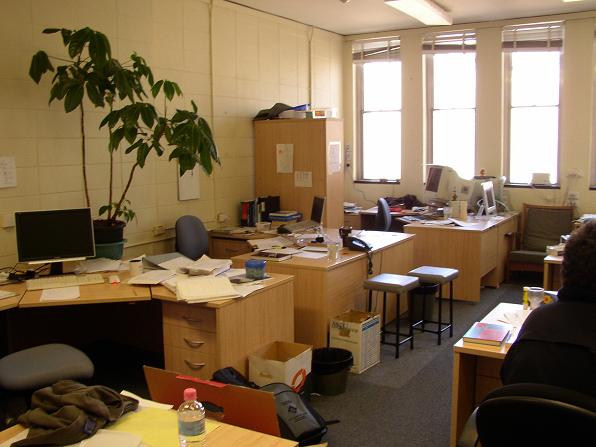
...we linguists get cute little two person offices.
On the other hand, their plants seem to be doing a lot better than ours are: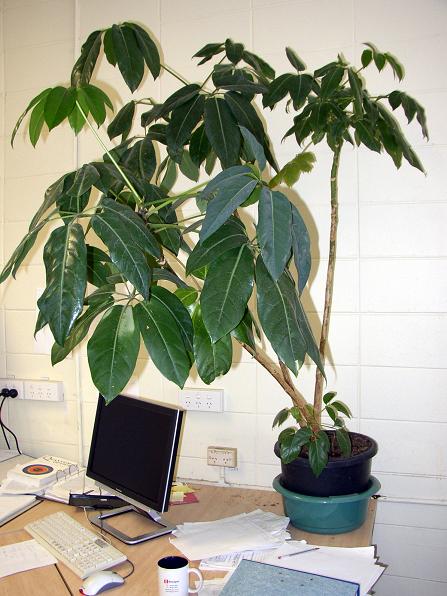
And while we make do with a creaky old blackboard and chalk...
...even the newest whiteboard isn't enough for the physicists: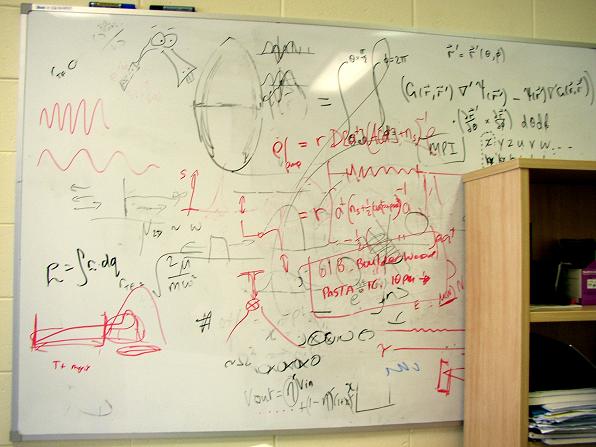
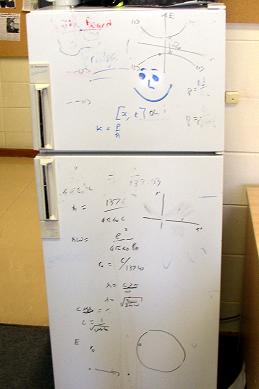
As we are on the topic of kitchens, I'd like to point out that theirs might have the upper hand in gadgets, but ours is a minimalist dream:

The posters they put on their walls might look cooler...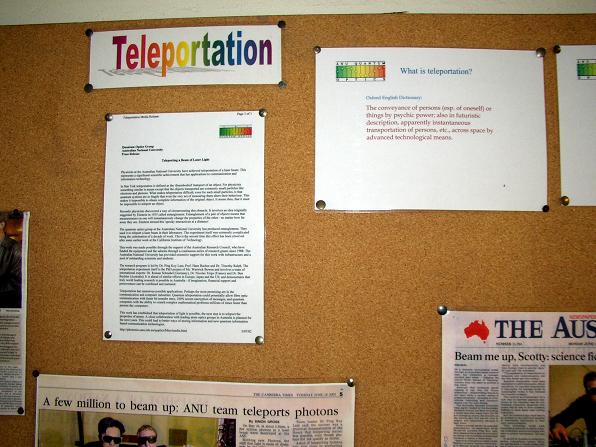
...but I'm sure you'll agree that ours disseminate more vital information: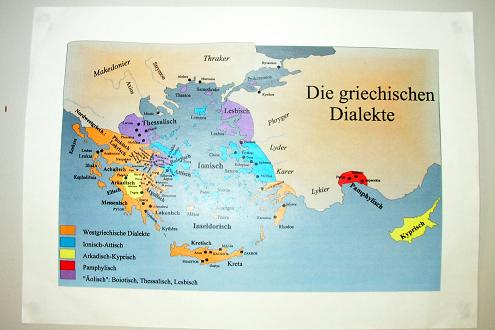
Sadly, though, in the area that matters to me most they are winning hands down: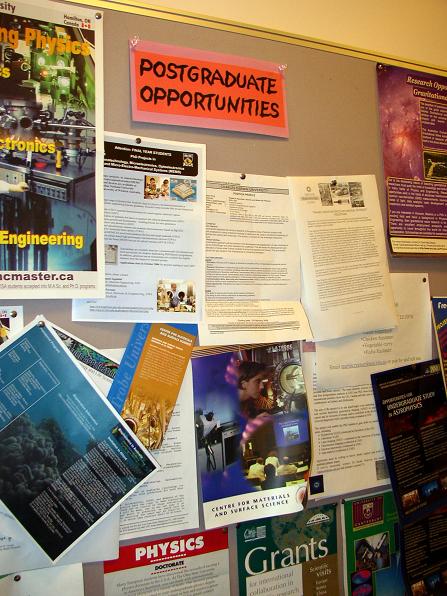
Tuesday, August 01, 2006
Geekman explains the universe
or StyleyGeek gets someone else to do her blogging for her. (Do you think this strategy would work for my thesis, too?)
In the comments to a post below, there was a discussion of a public lecture that was recently given on the topic of supersymmetry. Morton T Fogg missed the lecture and made the request that someone explain the lecture in one or two sentences. Miss M then fingered me as "a real live physicist" (as opposed to a dead one, I can only assume) and suggested I have a go. So here I go.
At the lecture the speaker didn't really say a lot about supersymmetry itself, and didn't really explain what it was when he did. This is understandable, since it was a public lecture, and he had to first cover a lot of physics background before he could even start talking about supersymmetry. It's also hard to get lay people excited about supersymmetry since it's really abstract. Still, he gets my admiration for even trying.
So here's my explanation of what supersymmetry is, assuming a moderately scientific background.
...
That was a five minute pause where I stared at the screen without writing anything. This is going to be difficult. Geekman adopts a lotus position and attempts to focus his chi.
Right. At the most fundamental level we know about, everything physical can be sharply divided into two classes with nothing left over. This division is normally made at the level of elementary particles (which are particles that appear to be absolutely fundamental and indivisible, i.e. not made up of anything else), but since everything is either one of these elementary particles or made up of collections of them, this division also applies to macroscopic objects.
The two classes are called bosons and fermions, and they have very different properties. Some of these properties are pretty abstract and don't make much sense outside a quantum mechanical analysis, but there is at least one property that has obvious, understandable consquences for everyday life: Bosons are friendly, fermions aren't. You can put as many bosons in the same place at the same time as you like; with fermions you can only have one in one place at any given time.
As you may now have guessed, practically all the stuff you see around you is fermionic. If you try to walk through a wall you will quickly become aware of this. You, the wall, not generally happy being in the same place at the same time. Feel free to try this at home - it's a very cheap and educational physics experiment, and probes fundamental properties of the universe.
Something that is bosonic, on the other hand, and is noticeable in everyday life is the photon (photons are particles of electromagnetic radiation). Light, radio waves, X-rays and so on all pass happily through each other without any problem.
Geekman un-adopts the lotus position as he's getting cramp, but tries to hold on his chi in case it proves useful.
Now, the next thing you have to know is that physicists like symmetry. A lot. A lot lot lot, even. If there's something asymmetric about their equations (making them ugly), they'll often stick in extra terms just to make them more symmetric (and elegant or beautiful), even if there's no justification for it. Amazingly, more often than not, these extra terms, in the fullness of time, turn out to actually be correct and describe extra stuff in the real world. The universe appears to like symmetry too. Good universe. Pretty universe.
I've used the term symmetry a lot, so it's probably time to explain it. There are all sorts of symmetries, and the ones that are most familiar to people are geometric ones. If, for example, I rotate a square through ninety degrees, it looks unchanged. Similarly if I reflect it though a diagonal and so on. But what does symmetry mean when applied to equations? Well, the same sort of thing, really. It means you can apply some transformation to one of the variables in your equation and the equation is still valid. One example might be if you take the solar system and move every object in it a metre to the left. The solar system ends up shifted but behaves exactly the same. This is equivalent to taking your equations that govern the movement of matter in a gravitational field and adding a constant to the variable denoting the position. If your equations don't still work after this change they don't respect this particular symmetry. The beauty about seeking symmetry in equations is that you can use symmetries that are a lot more abstract than the obvious spacial ones.
So, that's symmetry. Unfortunately we have this sharp dichotomy: bosons and fermions. Distinct, different, not symmetric. This makes physicists twitchy. Is is possible, they ask, to change the standard equations of quantum mechanics so that if we turned fermions into bosons the equations would still be correct? The standard equations don't respect this symmetry, but it's possible to construct equations that do, and they are indeed much more elegant. Beautiful, even. And if you look at these equations, you see they predict a whole lot more elementary particles that we haven't seen yet. If past history of physics is any guide, the fact that we have altered the equations to obtain beauty and seen new forms of matter predicted strongly suggests these new forms of matter actually exist.
That's the abstract motivation. Symmetry and beauty in the fundamental equations that describe reality.
There are a number of other motivations, but they're kind of too abstract to describe here. Suffice it to say that making our equations supersymmetric removes a number of inconsistancies in quantum mechanics, and it also appears to be required to make string theory work.
So, there's my quick and dirty description of supersymmetry for non-physicists, although it ran to a lot more than the one or two sentences requested by Morton T Fogg.
Subscribe to:
Posts (Atom)


